
In part 1, I talked about the healing through a prompt book – and pencil sketches in graphite. (Read that post here.) There’s a good discussion of thoughts along the process, and I hope you’ll give that a look as well as this post.
But here I want to talk through the sketches created during my healing process, but in watercolor and gouache. The graphite book was much better for days when I was braindead and just wanted to be given a prompt and draw it; but other days I was doing a deep dive study in art history, and it was a different experience for different kinds of days.
If you don’t paint, you might try this in pencil, markers, anything at all that you like to use; the process is truly the same, it’s a matter of giving yourself time to really learn about an artist through history, and seeing what elements of their work you might be able to incorporate in your own work.
Watch the rather long video below – and then read on for more tips on what I learned.
Tutorial: The Healing Power of Art (Sketchbook, part 2)
Watch the video below and scroll to the end to leave comments or questions — or click HERE to watch it on YouTube and leave comments over there. I read both dutifully!
SUPPLIES
Some product may be provided by manufacturers for review and use. Compensated affiliate links are here at no cost to you. I appreciate your support of my work with your purchases! Full affiliate and product disclosure | My trusted partners in art

Sketchbook
Medium
- Daniel Smith watercolors and gouache paints
Enjoy some video study time
Pick an artist you might like to learn more about – someone famous helps, as there’s plenty of resources on more famous artists. Any genre is fine!
On YouTube, search for the artist’s full name; hopefully there’ll be a documentary covering their life, and for some artists I’ve found several! Take your time watching through them, or as I did I listened through once, getting their life story in order, then watched it so I could focus more on the art. Maybe it was because my brain was fuzzy, but I found some of the videos I watched
If you don’t know who to start with, a great place to start is the Perspectives channel, anything by Waldemar Januszczak – his playlist is here. He’s a great presenter, entertaining and very smart. Then after watching a few, your home page will start populating other channels and videos in time, and the more you get into this, the deeper you’ll get into more great content.
Take notes. You might not want to paint right away but if you see a particular painting you might want to look up, writing it down will help. And if they mention another artist who they’re influenced by or studied under, that might be someone to look for next. Sometimes I just open another tab and type that thing into the search bar so it sits there waiting when I finish the video.
Note: There are some that are clearly made with AI (stilted scripts and narration) but I find their info is mostly accurate but some details can be wrong.
Choose an artist & artwork
The artist can be anyone, any genre, any medium – whether your medium or not! I found that I learned plenty from those whose work I wasn’t at all interested in previously, or art that I liked at all!
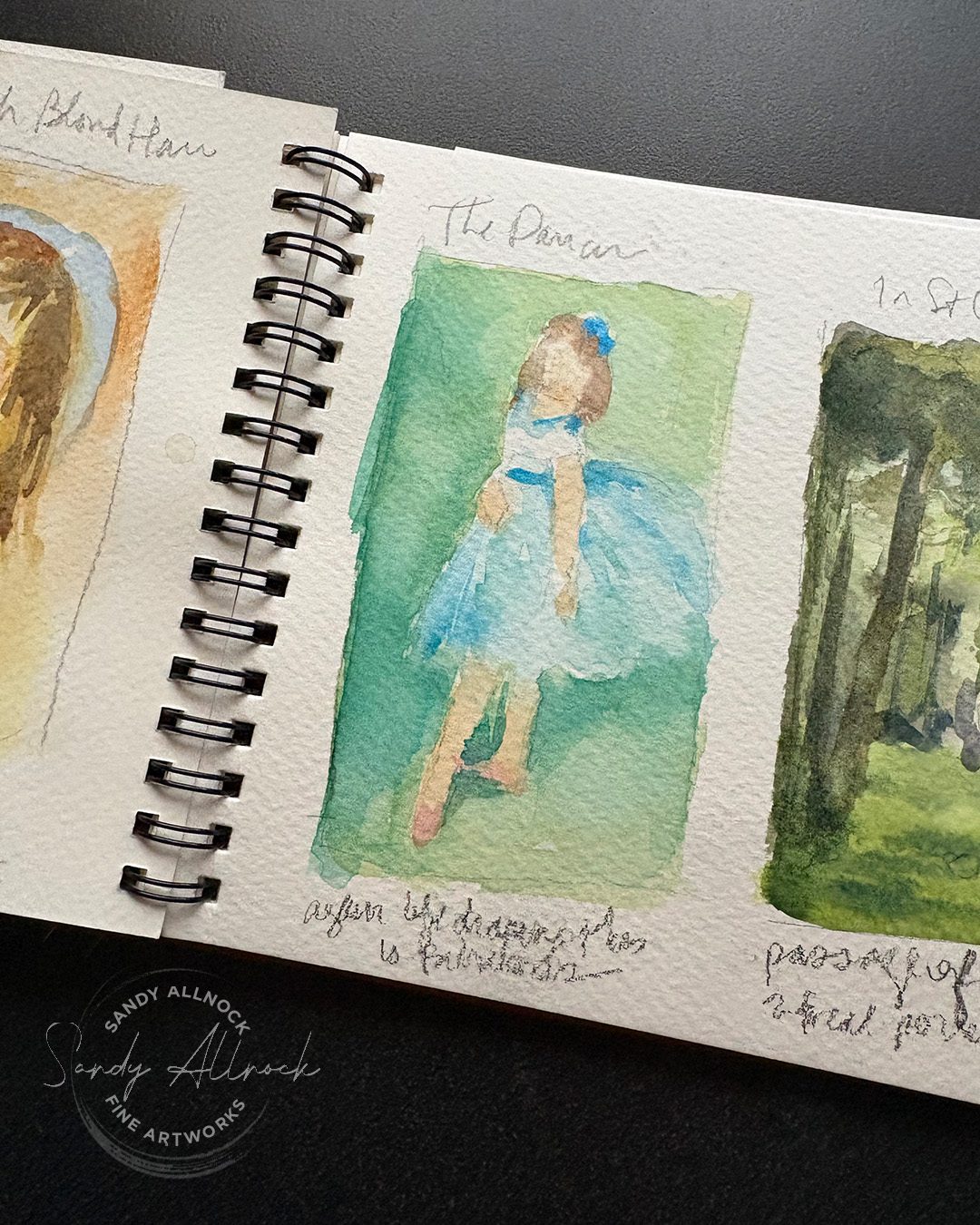
What do you like in their work? Composition? Color? Brushstrokes? What could you emulate in your medium, your subject matter, your style? Even if it’s just something to try once, it’s worth a little effort.
Search for photos of their work – but use the word “original”, and their full name. That’ll help Google to not bring up every COPY of that artwork; my recommendation is to select images from galleries, museums, or auction houses, as they’re incentivized to have pictures posted that are closest to what the artworks. Beware of anything selling “prints” as lots of those sites bump up the color to make it bright to draw attention to their version. Also beware if it’s on an individual artist’s website, it may well be their COPY of it. And if it’s on Amazon or Temu? Skip those entirely.
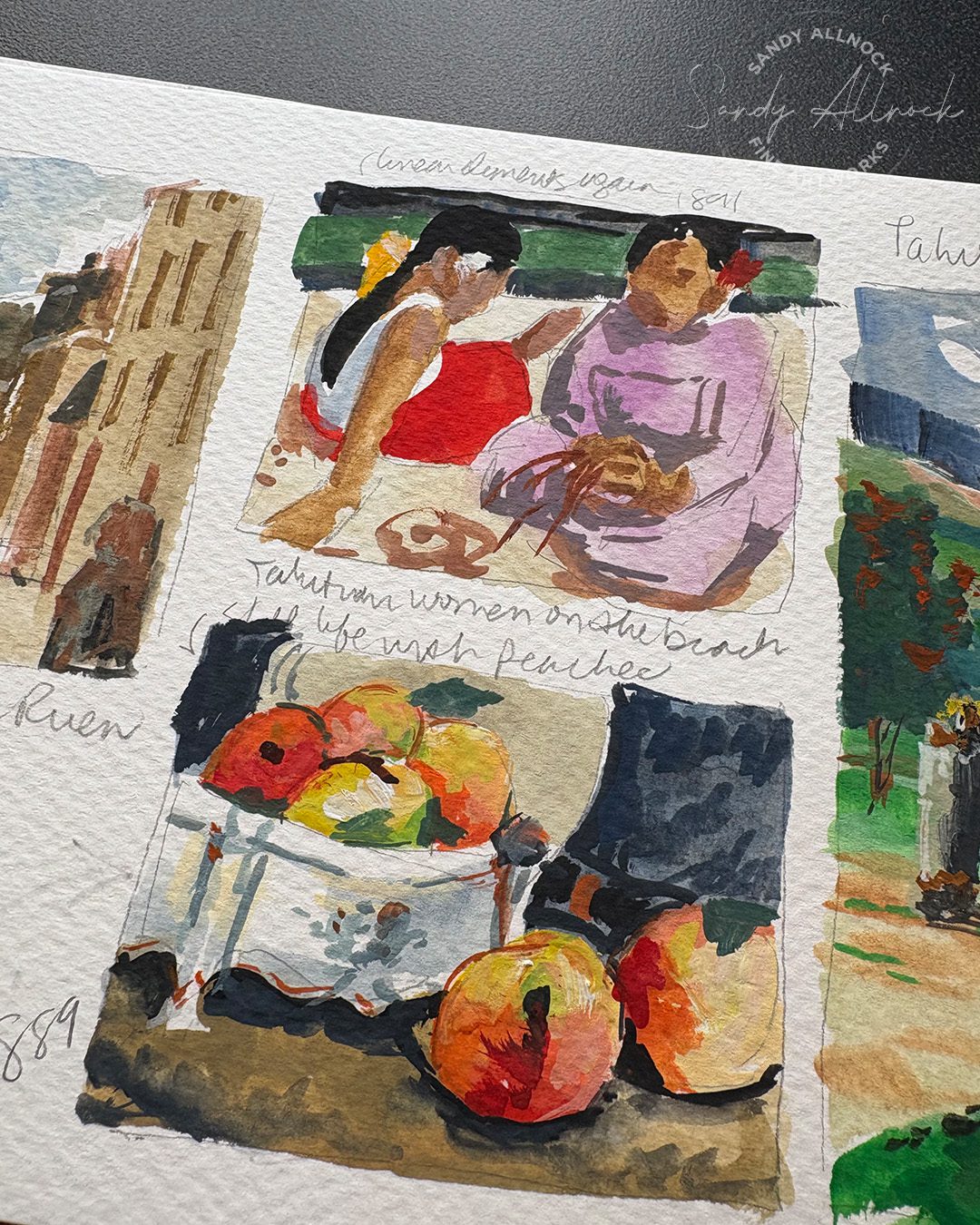
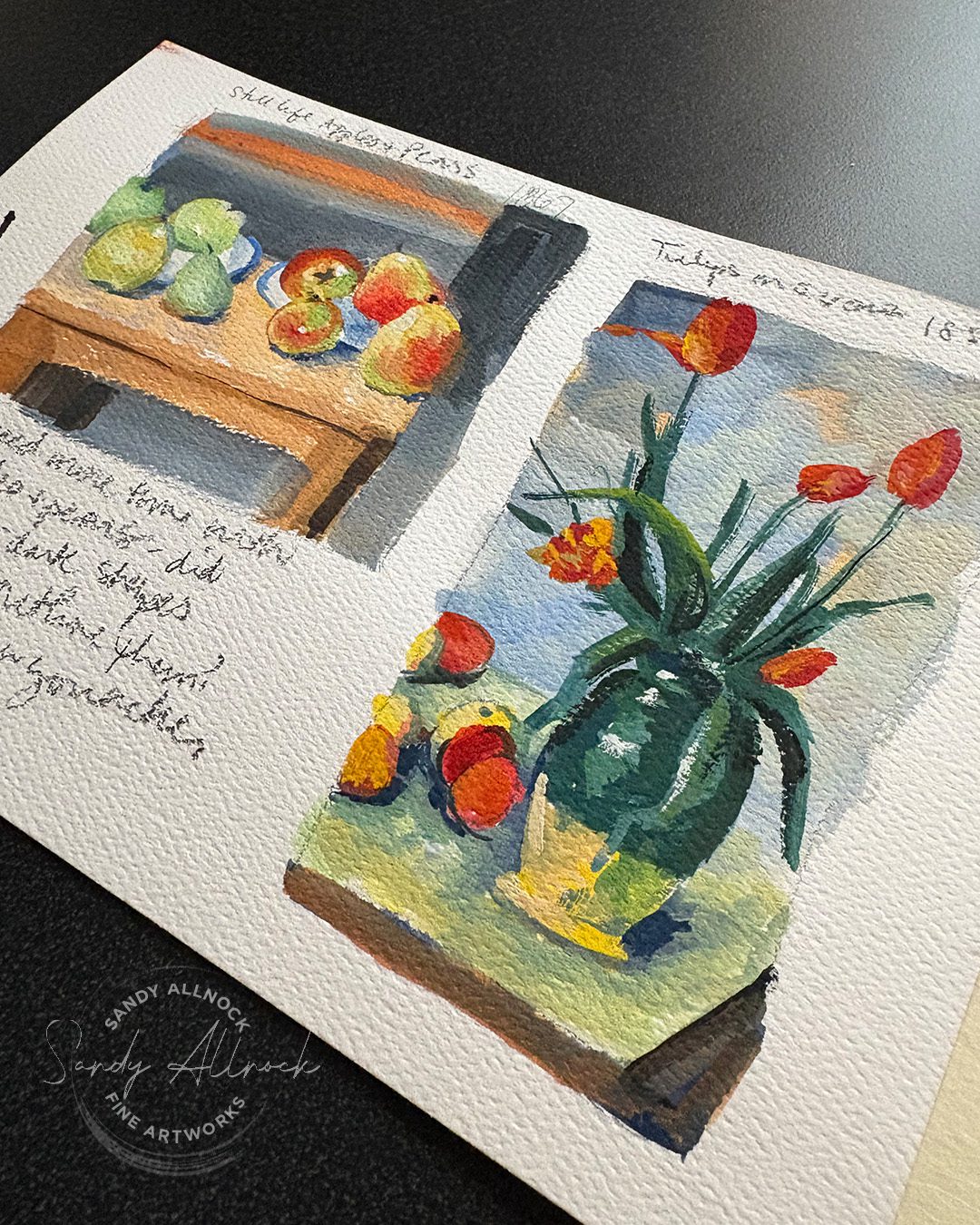
Create a thumbnail copy in your sketchbook. Don’t go for perfection, just for something that will remind you of the elements you studied. Make written notes as well, so you recall what you were aiming for.
You can do a bunch from one artist as I did, or do a study on a bunch of artists’ paintings of one subject to compare. Whatever floats YOUR boat!
Try a simple piece
If you have a day when you think you’re feeling better, and can get into your studio, try putting color on paper. Don’t set giant expectations for yourself; just set a goal of Color On Paper.
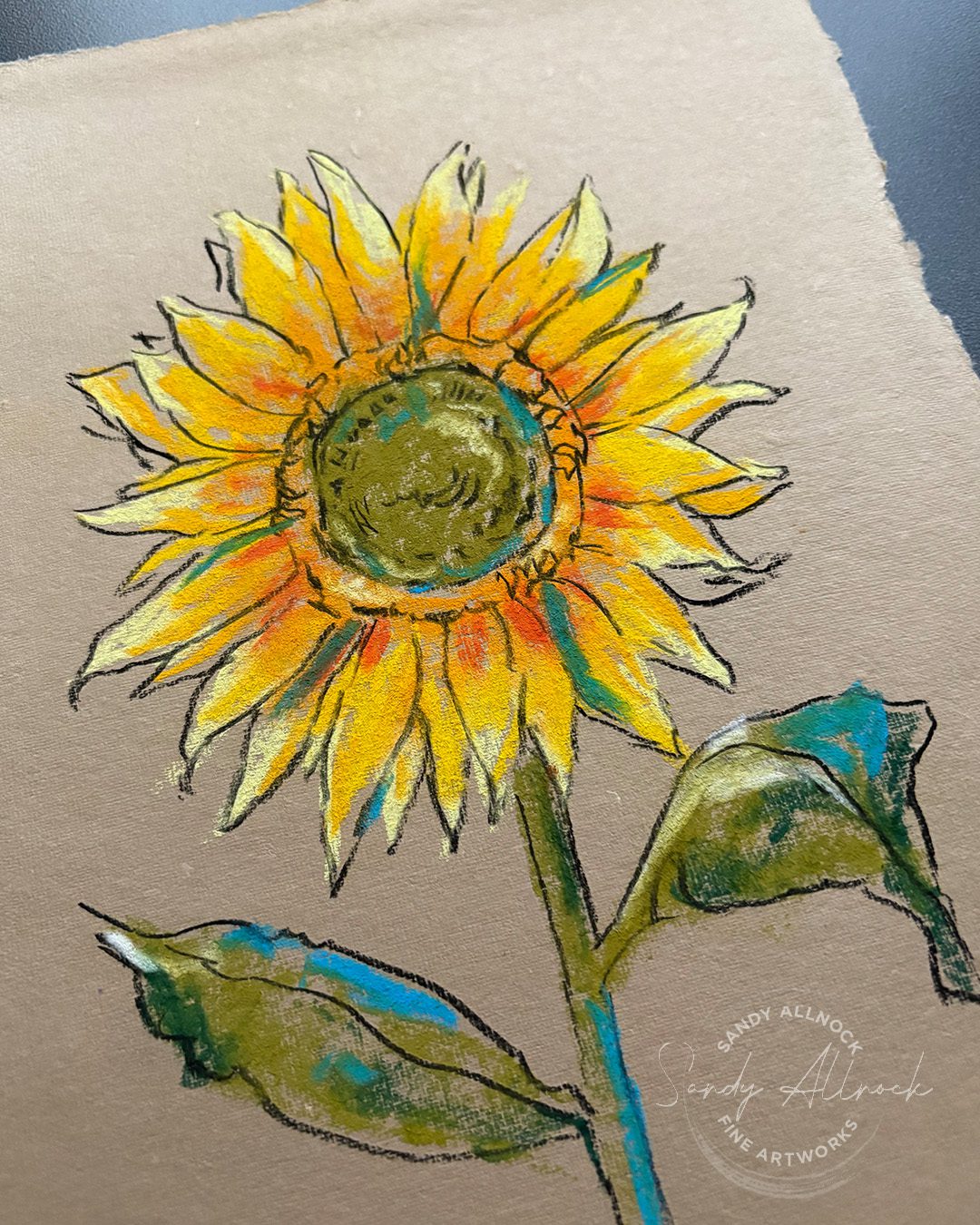
Pick something from your sketchbook that has an element that makes you happy. I had looked through my thumbnails and came across Van Gogh’s sunflowers, and decided on one that would keep me thinking about our friends in Ukraine. (It’s their national flower).
I chose a medium I haven’t used in eons that would truly be messy. I was having depth of field issues and knew tiny detailed work was no good that day but a big chunky pastel seemed like it could work. I put color on paper, and found it vaguely looked like a very messy sunflower. And that was enough for me.
But I remembered the outlines idea. I considered using an orange as Van Gogh did in one painting, but a charcoal pencil was the thing that was handy, so I used it instead. I let my lines become loose and wonky, no stress. And heck, I was tickled with the result of my little drawing! I also got to find out this handmade paper is stinky for pastels, so there’s that little learning too. LOL.
Subscribe to receive blog posts by email:
Pay attention to your core
Each time you create something, anything – a tiny sketch, a doodle on a sticky note, whatever it is – pay attention to how you’re feeling. Not just health issues, but does creating something make you feel different inside? Don’t judge your feelings on the basis of the quality of what you’ve made. It’s about how the act of creating may have changed you, your perspective, the amount of hope you feel.
When you do make something that tickles your fancy, celebrate it. You don’t have to share it – but tell yourself good things! Remind your mind and heart that you’re making progress. That you are more than capable of taking good steps. You’re not entirely a mess just because your human shell isn’t cooperating.
If you’re a journaler, write down what you’re thinking, how you’re feeling. Later your notes can help you see how far you’ve come.
Let the journey change you
Rather than ending up at the other end of a time in the wilderness with the feeling that “whew, now that’s over!” what would it be like to think, “Wow, I really grew from that!”
It may be just a small perspective change, but it might make you grateful for the season, which may also help you become a better cheerleader for others going through a rough time. Share your experience of healing so that you can provide hope when you tell people of your own experience.



This post really resonates with me—art truly does have a deep, healing energy. I recently came across King’s Healing Art, where the artist creates spiritually inspired pieces designed to support emotional balance and manifestation. It’s amazing how intentional art can transform not only our spaces but our inner states too. Thank you for sharing your sketchbook journey—it’s incredibly inspiring!
Visit : Kingshealingart.com
I really enjoyed this video and mini art history lesson! It’s what I call a big coffee mug moment! I would be so interested in the subject that I could finish my huge mug of coffee in one sitting. Thank you for sharing your journey and how proactive you’re being.
Glad it’s helpful! Knowing I had another week of videos to fill after all my pre-recorded stuff, I set myself a goal of finishing that sketchbook in time to get a talky-video done. Next week creative stuff starts up!