
Have you ever stumbled on an idea that got you so excited and you kept asking “How am I only finding out about this now?”
That happened to me. Around Thanksgiving time, I was wasting time on YouTube (it’s not all a waste but that day it seemed to, until….) the algorithm showed me a video by Marion, and I nearly didn’t click. I had heard of Phrenology and knew it was bad, but…I clicked anyway. How could something in her beautiful thumbnail be related to that other thing I knew?
(see her video later in this post)
Well it turned out that I was wrong. 100% wrong. I had the wrong word! It wasn’t phrenology. It was phenology. A completely differnet world!
In the video below I’ll explain the difference, then get into how you can get started like I am.
Tutorial: What is a phenology wheel?
Watch the video below and scroll to the end to leave comments or questions — or click HERE to watch it on YouTube and leave comments over there. I read both dutifully!
SUPPLIES
Some product may be provided by manufacturers for review and use. Compensated affiliate links are here at no cost to you. I appreciate your support of my work with your purchases! Full affiliate and product disclosure | My trusted partners in art

My reasons to study phenology
Pheno;ogu is the study of cyclic and seasonal natural phenomena, especially in relation to climate and plant and animal life. We already do this in our daily lives – we look out the window to look at the sky, or stick our hand out the door to decide what jacket we need that day. You’re already a scientist, how cool is that?
However, if we don’t document what we learn about the natural world around us, we won’t be learning as much as we could. I’m finding that the further we move into climate changes, the more interested I am in finding out what the effects are on the area I live in – and will I be able to detect any of it? I have a “gut” feeling about when summer used to arrive, how many REALLY hot days we used to have vs now. But nothing tangible. It might be time to start taking notes!
I also want to start creating art directly from objects in front of me, whether inside or outside, and making a commitment to do that more regularly can’t possiblly be a bad thing. My word for 2025 is “observe” – and phenology wheels seem to be the perfect thing for me!
The questions I came up with that should help you decide if/how you want to join in:
DECISION 1
What do you want to observe? Plants overall or one? Wildlife/birds? Skies? Rocks? Soil types? Depends on what’s around you Look for apps to help identify plants and animals.
- iNaturalist, identifier w social component so you can share info
- LeafSnap: plants, flowers, fruits, and trees
- Merlin: birds
- Seek: for plants, insects, fungi, and wildlife
Rockd: nearby geologic units - Skyview: An app that can help you identify stars
DECISION 2
- How often will you journal?
- Daily 365 or 31? Weekly 52? Monthly 12?
DECISION 3
What data will you capture?
- Sunrise / sunset?
- Plant ID?
- Cloud types?
- Temperature?
- Humidity?
DECISION 4
What art medium will you use? What makes sense?
- Paper type?
- Size?
DECISION 5
What format will you use?
- Portability or in studio?
- Normal journaling?
- Accordion sketchbook?
- Wheel?
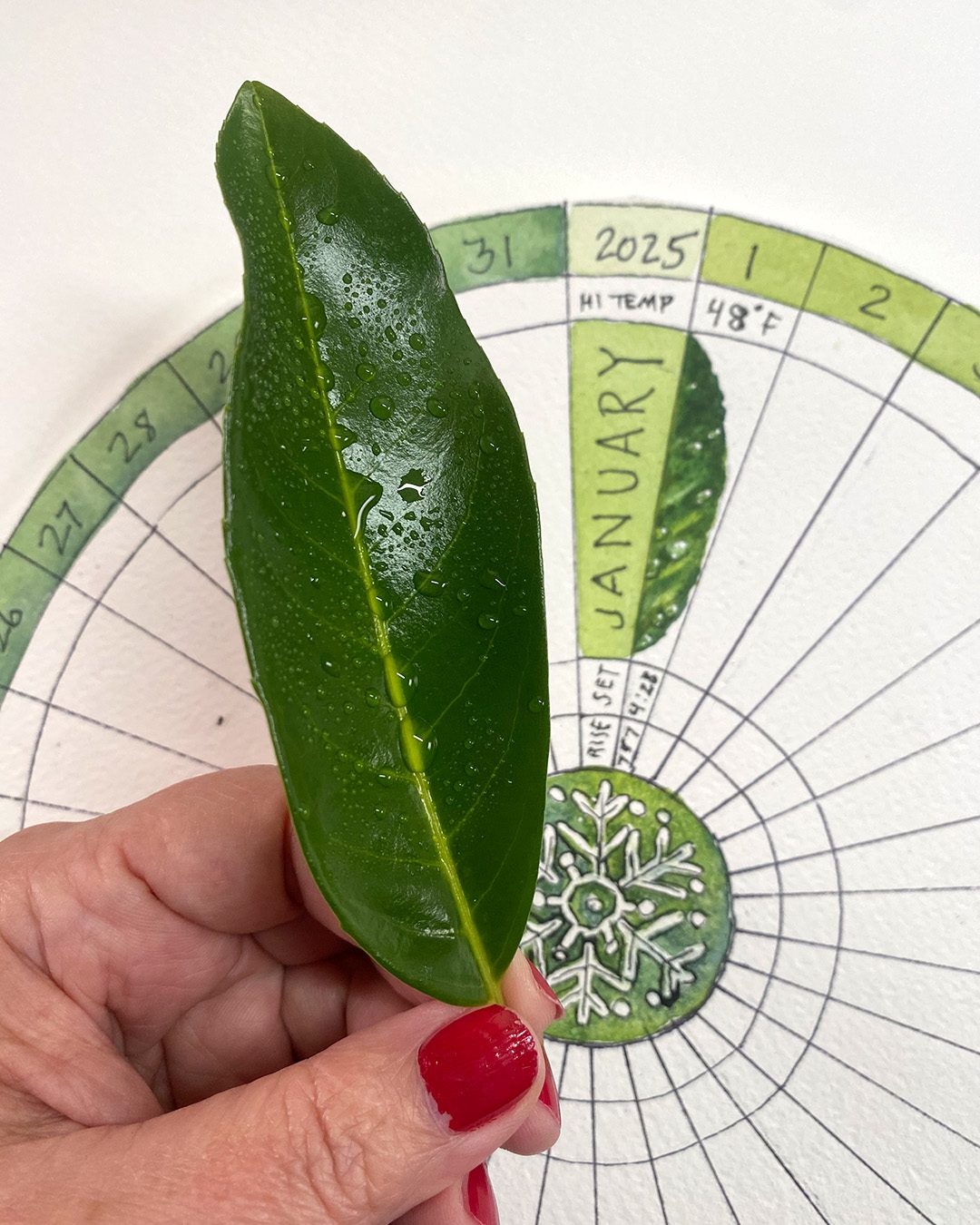
One-month phenology wheel
Dividing a circle into 32 slices or sectors gives you enough to create any month – with 1 or more extra spaces left. You can use those for bonus entries, or combine them into a bigger pie slice to create a title for it or write notes about what your goal was. Lots of options!
I’ll be collecting data on the high temperature for each day, along with the times for sunrise and sunset. The art will be observing everything green around me – both in my yard (lots of weeds, ha!) and on my daily walks. Hopefully the dogs will help me pick out plants to observe each day, too!
My plan is certainly not “the” way to do this. You can pick anything – document clouds in the sky. Tree bark all around your town. Bugs you see. If you’re at the coast, try rocks and shells! The data you collect should be what YOU are interested in.
My measurements: full circle is 10″. Dates are 1/2″. Temp is 1/4″, sunset/sunrise are each 3/8″. Center is a 2″ circle, drawn at 1″ from the center point.

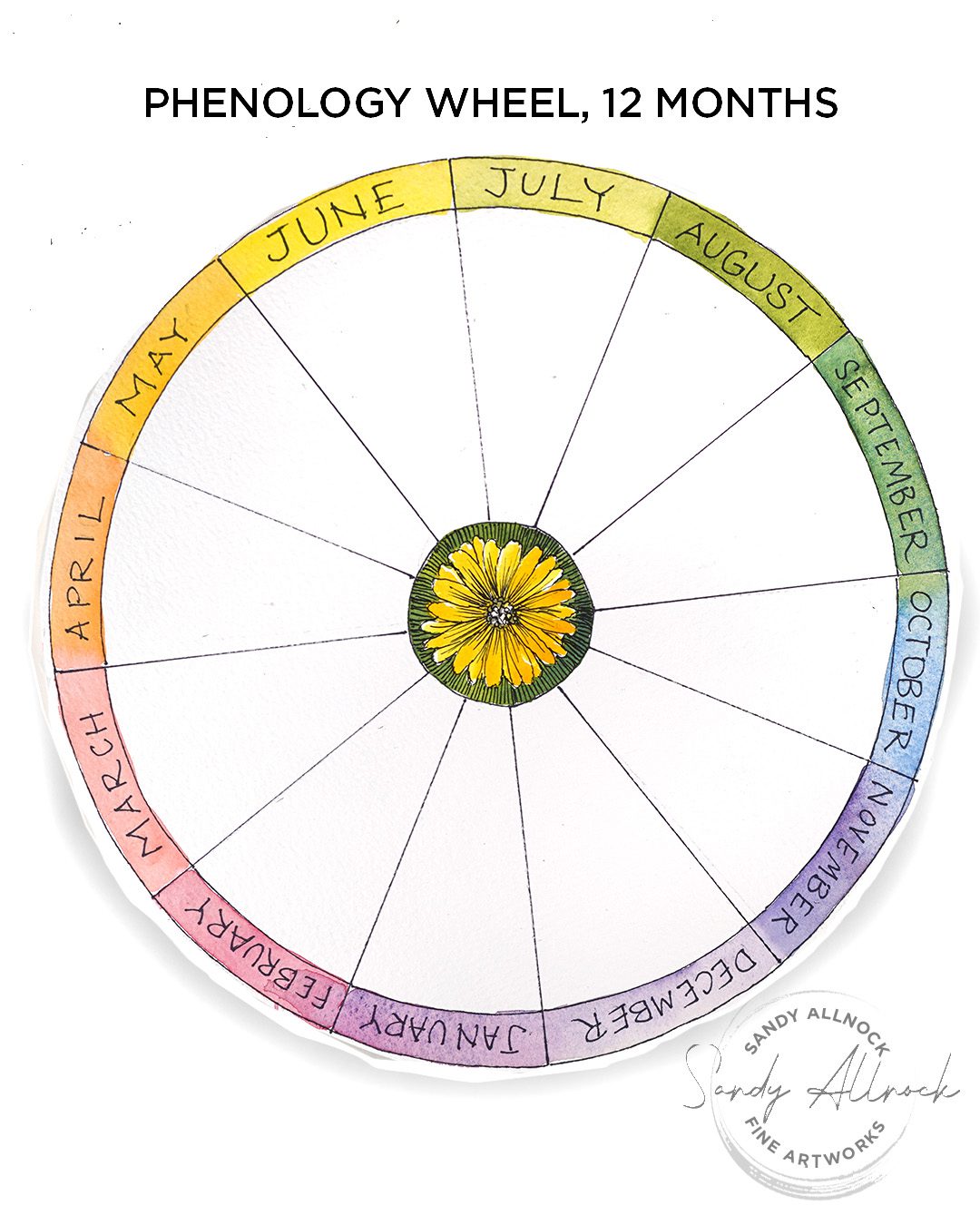
Once a month journaling
I’m not certain how I’ll use this – but perhaps as I work through my January wheel I’ll figure that out. If you have ideas let me know! Just remember this one is mathematically a little tougher; instead of dividing in half, you have to divvy each of the 4 quadrants in THREE so the angles are different.
My measurements: full circle is 10″. months are 1/2″. Center is a 2″ circle, drawn at 1″ from the center point.
Subscribe to receive blog posts by email:
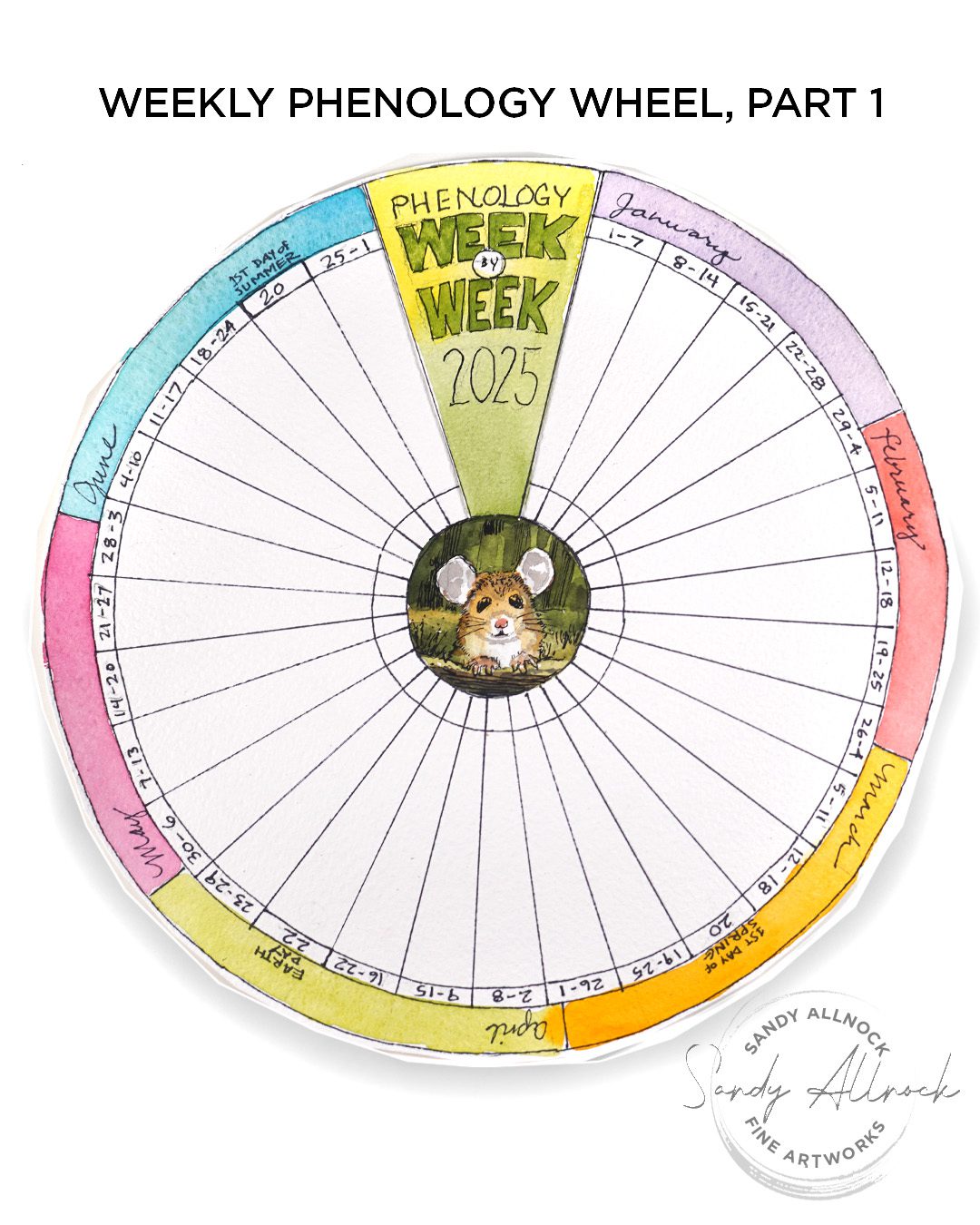
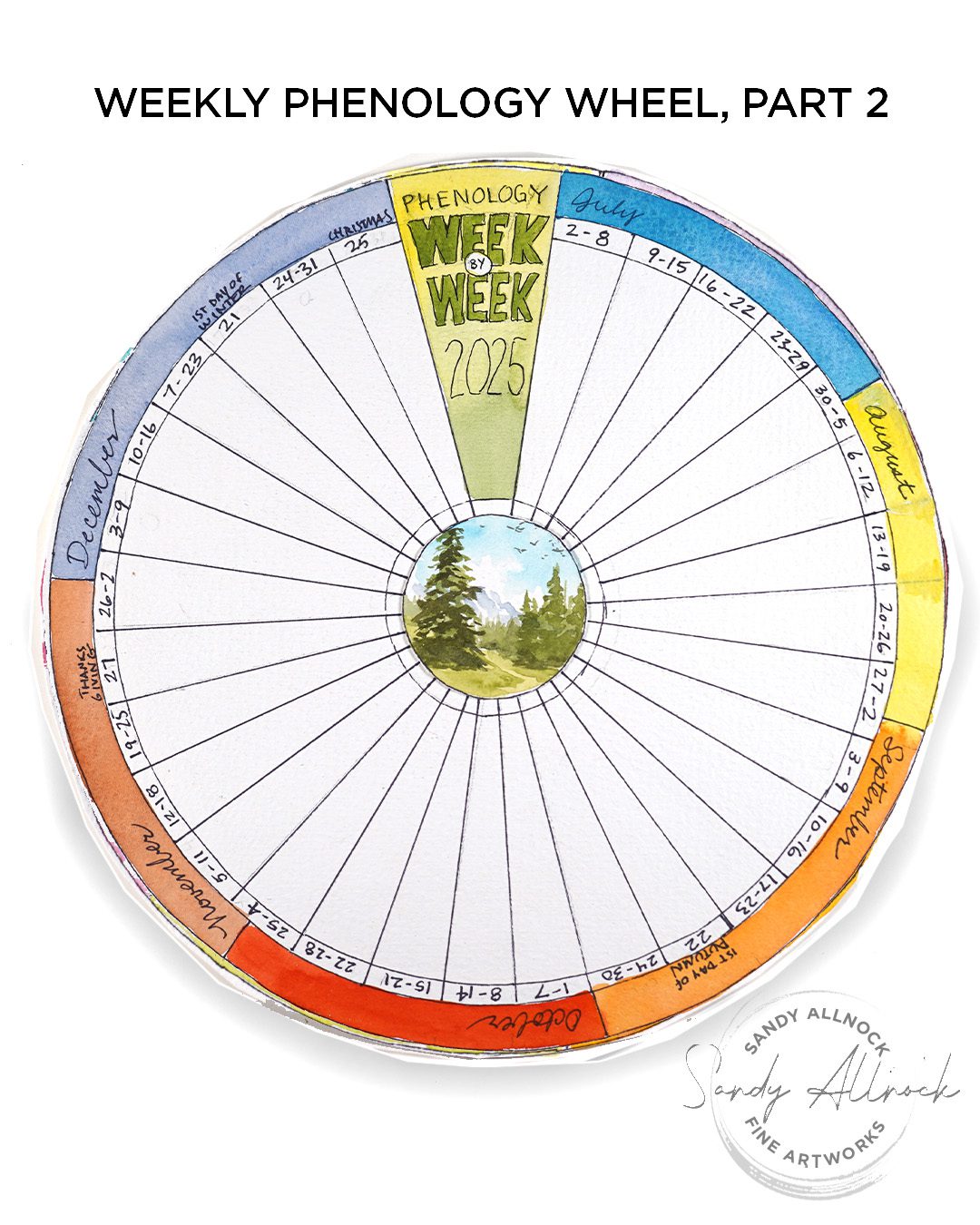
Weekly journaling
I was thinking about what I’ll do when I get distracted – which is inevitable! Once I start paying attention to green plants, what if I find a flower blooming early? What if a bee shows up in January!? The weekly entries will, in my current thinking, be for whatever I found most special that week. It could be one of the green things, but could also be something entirely unrelated.
This one needs 2 wheels which will give you 64 slots. I wrote out the days for each week, then inserted some special days that I can imagine journaling something extra for – like Earth Day, first days of seasons, etc. You might also just punctuate the charts with 12 special entries of whatever kind you want. Just write it all in pencil first! I had to erase mine and move stuff around.
My measurements: full circle is 10″. Months are 1/2″. Week dates are 1/4″, and inner data ring might be which day of the week I found the special thing, to see if I am more observant on a particular day. Center is a 2″ circle, drawn at 1″ from the center point.
The video that inspired me!
Marion’s video came up through the algorithm, and I was delighted! See her video below or click HERE to watch it on YouTube.
I’m tickled to follow Marion’s lead!
I know she’s not the inventor, but hey, she was the one who made such a lovely video that it got my attention! Hope you’ll join in on the fun, too.





How wonderfully explained and what a personal challenge and enriching experience to undertake! Thank you so much for this inspiration! I believe that I’ll introduce this to my youngest granddaughter and maybe we can do this activity together.
Sandy, I love your detailed descriptions. This is what I was looking for. The funny thing though is I found Marion’s blog before I asked you whether you had a class on how to create a Phenology Wheel. This blog piece is a class in itself! Thank you, thank you!!
I loved how this helped Marion with her watercoloring skills. That is an incentive by itself!
Oops, forgot to answer the questions:
Decision 1: I would love to do one on birds at my bird feeder. If I had to pick just one, it would be the junco.
Decision 2: I would do it weekly. I would hope to observe when they arrive and leave throughout the year.
Decision 3: I would record the weather for the week and are the birds arriving in groups or individually.
Decision 4: I got to go with watercolor paper. I need to improve my skill just like Marion.
Decision 5: I love the wheel idea, so I probably will use that. Maybe a sketchbook would be fun too.
Yes yes yes! Wonderful idea.